Exclusive: Timber NSW wants “Item 17” added to Australia’s Russia sanctions list — a move that would cover all timber sourced directly or indirectly from the Russian Federation.
Timber NSW, the 120-year-old industry body representing the NSW hardwood industry, has lodged a submission to a Senate inquiry, lobbying the Albanese government to capture all Russian-sourced timber in its sanctions regime, including engineered wood products routed through China and Southeast Asia. Wood Central can reveal the submission was filed with the Senate Foreign Affairs, Defence and Trade References Committee yesterday, with the peak body pressing the federal government to close what it describes as Russia’s shadow timber trade through Chinese and Southeast Asian supply chains.
The submission, signed by Timber NSW Chief Executive Maree McCaskill, calls on the federal government to amend the Autonomous Sanctions (Import Sanctioned Goods – Russia) Designation 2022 with a new Item 17 clause covering all timber and timber products directly or indirectly sourced from Russia. The mechanism would match the European Union’s tightened sanctions adopted under EU Council Regulation 2026/506 on 23 April 2026, which closed similar third-country routing loopholes across the bloc.
Arguing that tariffs alone cannot close the loophole because they rely on country-of-origin declarations, McCaskill said Australian Customs Notice 2022/21 — which applied a 35 per cent additional duty to Russian and Belarusian goods from 25 April 2022 — has failed to stem indirect imports. “A policy outcome through any tariff increase will be ineffective,” McCaskill said.
[
](data:image/svg+xml;base64,PHN2ZyB4bWxucz0naHR0cDovL3d3dy53My5vcmcvMjAwMC9zdmcnIHZpZXdCb3g9JzAgMCAxMDI0IDc2OCc+PC9zdmc+)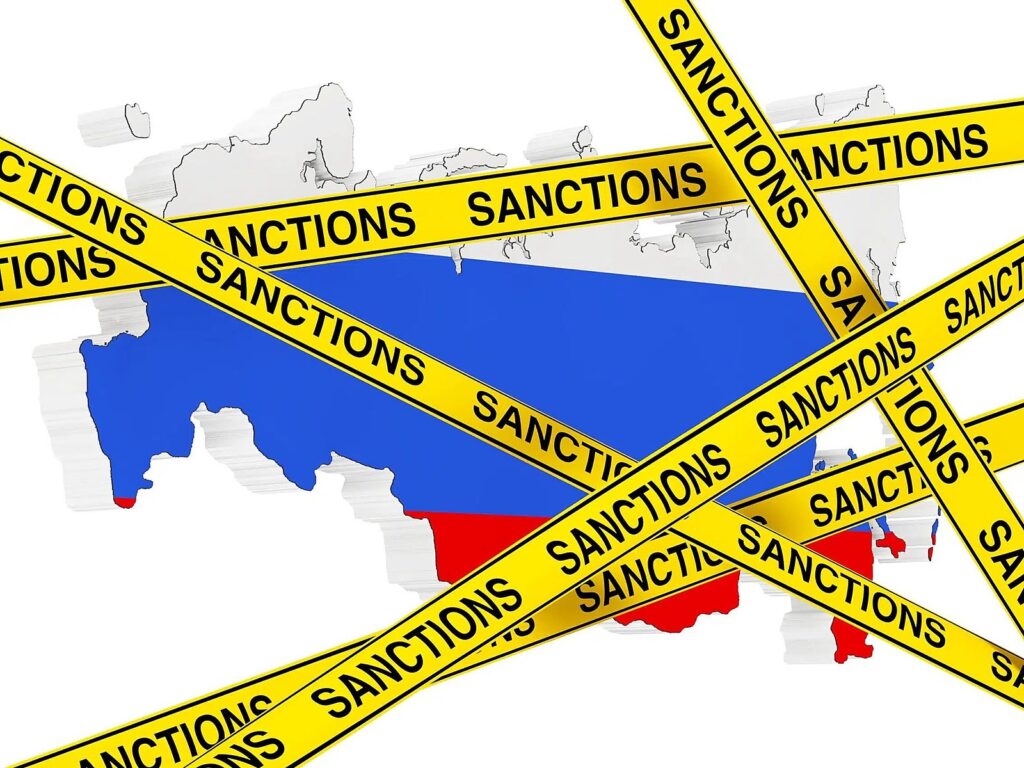
The EU banned Russian timber imports under its fifth sanctions package in April 2022, and FSC and PEFC both suspended Russian certificates from their global certification schemes the same year, sealing Russian fibre out of every major Western market. (Image Credit: Stock Illustration ID: 719426440)
Referred by the Senate on 5 November 2025, the inquiry will accept public submissions until 12 June, with a final report due back by 20 August. At least 26 submissions are already on the public register, including from Australian National University legal scholar Anton Moiseienko, financial integrity firm KordaMentha, the Minderoo Foundation, Transparency International Australia and the Department of Foreign Affairs and Trade.
Most of the submissions so far on the public register focus on the “blood oil” loophole, with Australia identified as the single biggest buyer of petroleum products refined from Russian crude in third countries. The energy sector and Ukrainian community submitters include the Centre for Research on Energy and Clean Air, the Australian Institute of Petroleum, Senator Fatima Payman, the Australia-Ukraine Chamber of Commerce, B4Ukraine and the Australian Federation of Ukrainian Organisations.
Wood Central understands that a number of additional peak bodies across the Australian timber supply chain are preparing submissions to the inquiry in the coming days. The Albanese government is under growing pressure to align Australia’s regime with those of the European Union and other Western nations, with Russian timber among the Kremlin’s highest-value transborder trades.
[
](data:image/svg+xml;base64,PHN2ZyB4bWxucz0naHR0cDovL3d3dy53My5vcmcvMjAwMC9zdmcnIHZpZXdCb3g9JzAgMCAxMDI0IDc2OCc+PC9zdmc+)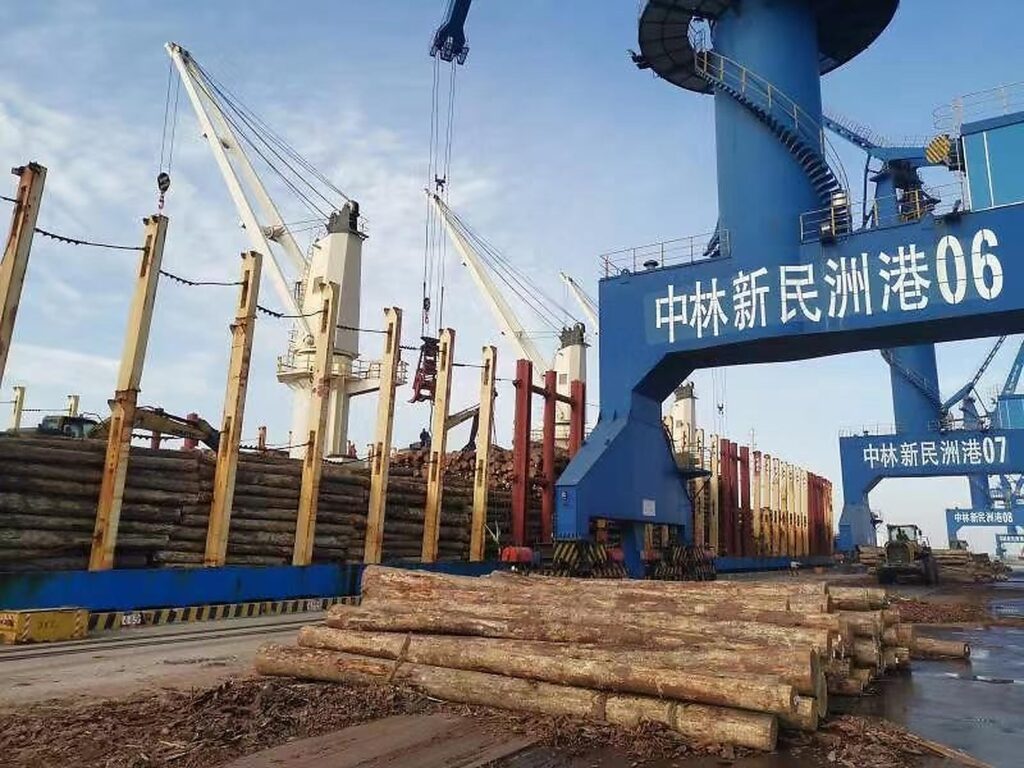
A Chinese log port stacked with imported softwood logs, gantry cranes operating under signage for Zhonglin Xinminzhou Port — one of the entry points feeding the Chinese mills that produce more than 70 per cent of the world’s plywood. China imported more than 11.2 million cubic metres of Russian timber in 2024, with Russian softwood lumber supplying 63 per cent of total Chinese softwood imports. (Photo Credit: Supplied)
Chinese-controlled mills now produce more than 70 per cent of the world’s plywood through operations across Vietnam, Indonesia and Malaysia, with Russian softwood lumber supplying 63 per cent of Chinese softwood imports. China imported more than 11.2 million cubic metres of Russian timber in 2024.
Australian importers were major end-users of these products before the 2022 invasion, with Russian-origin LVL formwork and engineered beams accounting for 40 to 50 per cent of the local market — a flow Wood Central has tracked through fresh Australian Bureau of Statistics data, raising new concerns about Chinese LVL dumping into the Australian market. The submission cites US Forces in Europe commander General Alexus Grynkewich’s March 2026 congressional testimony as evidence that current sanctions are failing to constrain Moscow’s military spending, even as Russian timber still accounts for 1 to 1.3 per cent of GDP and 2.4 per cent of export revenue.
Beyond the sanctions amendment itself, the submission argues the Illegal Logging Prohibition Act 2012 should be amended to capture any sanctions declared under the Autonomous Sanctions Act 2011, drawing on the Department of Agriculture, Fisheries and Forestry’s DNA, stable isotope and wood-anatomy testing capabilities. The push follows Wood Central’s reporting that 50 per cent of Australia’s imported timber fails traceability testing and NATO-aligned intelligence finding timber among the hardest-hit Russian commodities under the European Union’s tightened sanctions regime.