WASHINGTON, April 29, 2026 /PRNewswire/ – As Canada doubles down on its well-documented unfair trade practices in the softwood lumber sector by pushing out billions of dollars in new subsidy schemes aimed at undermining President Trump’s policy initiatives to further grow the American forestry sector, the U.S. Lumber Coalition is calling on Canada to instead focus on addressing the problem of its massive, unsustainable, and market-disrupting excess lumber capacity.
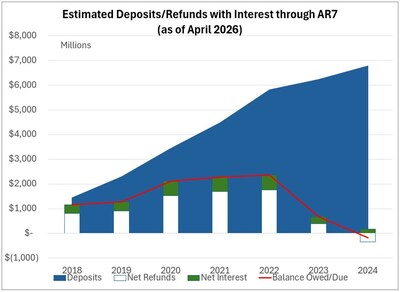
Estimated Deposits/Refunds with Interest through AR7(as of April 2026)
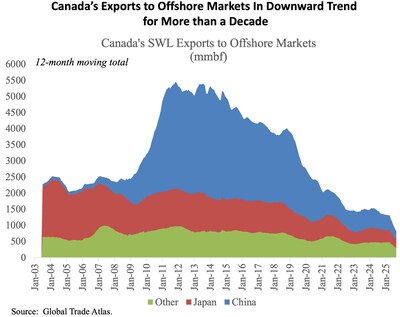
Canada’s Exports to Offshore Markets In Downward Trend for More than a Decade
Canada consumes on average around seven and a half billion board feet of softwood lumber annually, but, through its multi-billion dollar taxpayer-funded subsidy schemes, maintains an annual production capacity of 27 billion board feet. For example, British Columbia is now required to export 85 percent or more of its entire production, and as high as 80 percent of these exports are dumped into the United States as there are no other viable volume markets to absorb the excess production.
“President Trump’s strong trade law enforcement steps, which include the ongoing antidumping and countervailing duty cases and the Section 232 tariff measures, have successfully pushed Canada’s market share in the United States from 32 percent to around 19 percent,” stated Steve Swanson, CEO and Executive Chairman of Swanson Group and Chair of the U.S. Lumber Coalition. He added that “with the President having set the stage to change the landscape of America’s forestry sector and forestry jobs for the next hundred years, it is now time to take all necessary steps to fully address Canada’s massive and unsustainable excess lumber capacity problem.”
“Canada’s massive and unneeded lumber production capacity is the underlying cause of Canada’s continued unfair trade practices that have been so incredibly harmful to U.S. workers, their companies, and forestry dependent communities. Forcing Canada to substantially and permanently reduce its market-disrupting excess lumber capacity would eliminate the need for Canada to unload or dump that excess capacity into the U.S. market, thus further reducing Canadian U.S. market share to the low single digits. This would resolve, once and for all, the U.S. – Canada softwood lumber trade issue,” added Swanson.
Canadian Prime Minister and Premiers on camera stating that Canada subsidizes its lumber industry – and they want more.
U.S. LUMBER COALITION RESPONDS TO RECENT COMMENTS BY CANADIAN OFFICIALS:
- Canada’s Border Services Agency launches investigations into the alleged dumping and subsidizing of certain plywood products from China, stating that the investigation is being conducted to “determine whether decorative and other non-structural plywood is being sold at unfair prices in Canada (dumped), subsidized, or both … [because the domestic industry states] … that as a result of an increase in the volume of the dumped imports, they have suffered material injury in the form of lost sales, lost market share, price undercutting, price depression, price suppression, poor financial results, reduction in capacity utilization, reduced employment, and lost return on investment.”
U.S. Lumber Coalition Response: “The U.S. Lumber Coalition is pleased to see that Canada, much like the United States, uses its antidumping and countervailing duty laws to address the exact same trade problem that the United States faces as a result of Canada’s well-documented unfair trade practices in softwood lumber. This is a step in the right direction to Canada admitting the legality and purpose of trade law enforcement against unfair trade practices, rather than complaining about being subject to U.S. trade laws. It is past time for Canada to dismantle Canada’s massive excess softwood lumber capacity that is at the core of Canadian unfair trade practices,” stated Zoltan van Heyningen, Executive Director of the U.S. Lumber Coalition.
- Canadian Prime Minister Carney: “You know what’s an irritant? … all the tariffs on forest products. Those are more than irritant. Those are violations of our trade deal [with the United States].”
U.S. Lumber Coalition Response: “Prime Minister Carney’s statement was illuminating as it clarified the Canadian mindset regarding the function of the USMCA for Canada—mainly that the USMCA should give Canadian industries, including its softwood lumber industry, unfettered access to the U.S. market even when it engages in egregious unfair trade practices to the detriment of U.S. workers and industry. Needless to say, the U.S. Lumber Coalition does not agree with Prime Minister Carney that the United States enforcing its trade laws is a ‘violation’ of the USMCA. To the contrary, Canada abusing its access to the U.S. market by dumping its massive excess lumber production into the U.S. market is a clear violation of the spirit of USMCA,” stated van Heyningen.
- British Columbia Premier Eby recently stated, “There’s $8 billion in a tariff bank account that is jointly held between Canada and the United States,” further stating that it was ridiculous that the United States imported lumber products from non-Canadian sources, concluding that “the [American] liquor won’t go back on the shelf until that is addressed.”
U.S. Lumber Coalition Response: "It is remarkable that Canada spends millions of Canadian taxpayer-funded dollars on Washington, DC, attorneys litigating the U.S. softwood lumber trade case on behalf of Canada, yet British Columbian officials continue to demonstrate a spectacular level of ignorance and entitlement when it comes to this issue. It is estimated that as of 2024, the seventh administrative review period, Canadian softwood lumber companies paid close to $7 billion dollars in duties. As the seventh administrative review nears completion, Canada is slated to receive zero refunds on a cumulative basis. In fact, when accounting for interest, Canada is slated to owe an additional $175 million dollars and counting for dumped and subsidized imports through calendar year 2024.
There is obviously no “joint tariff bank account.” There is only the Treasury Department of the United States that will liquidate these funds into the general coffers of the United States. We sincerely hope that Canadian taxpayers are paying close attention as their federal and provincial governments keep doling out billions of dollars in subsidies to an unsustainable Canadian softwood lumber industry that eventually pays those funds to the U.S. government in the form of U.S. duties and tariffs at the border. This harmful cycle must come to an end," stated van Heyningen.
- Canada-U.S. Trade Minister LeBlanc stated that the Trump Administration was weaponizing Canada’s dependency on the United States.
U.S. Lumber Coalition Response: “It is Canada, not the United States, that has created Canadian dependence on the United States. Softwood lumber is a prime example. Canada has built an excess capacity problem for its softwood lumber industry. For example, British Columbia is now required to export 85 percent or more of its entire production. As much as 80 percent of these exports go to the United States. It is Canada that has weaponized its dependency on the U.S. market by facilitating Canadian exporters’ dumping practices into the U.S. market through its multi-billion dollar federal and provincial government subsidy schemes. This abuse of the U.S. market must come to an end, and the first step is to dismantle Canada’s massive and disruptive softwood lumber excess capacity,” stated van Heyningen.
- Canadian Minister of Energy and Natural Resources Hodgson, announced the implementation of a strategy to “pivot Canada’s wood exports away from the United States,” including targeting China and other Asian markets for its lumber products.
U.S. Lumber Coalition Response: "Canada attempting to pivot away from the U.S. market through diversification is nothing new, and no amount of PR statements by any provincial and federal officials will render this a novel idea. Canada has actively tried to make gains in non-U.S. markets for the last seventeen plus years. Unsuccessfully. We all remember when former British Columbian Forest Minister Pat Bell initiated a valiant effort in 2009, with only temporary success.
The reality is that as long as Canada maintains its massive excess and unneeded softwood lumber production capacity, Canadian lumber producers will unload their excess production into the U.S. market by dumping their product at whatever price is needed to move their product, and then will turn around expecting Canadian taxpayer-funded subsidy schemes to maintain their production facilities. All at the expense of U.S. workers, companies, and forestry dependent communities. We must and will end this cycle of abuse of our market," concluded van Heyningen.